Showing posts with label Henry Chadwick. Show all posts

Sunday, April 24, 2022

Before the Bums 4/24/1890: Brooklyn Bridegrooms Home Opener Postponed by Rain

From the desk: FINGERPRINTS OF DEM BUMS

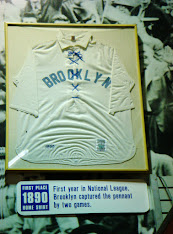
In baseball's sixth ever World Series clash of 1889, the National League New York Giants defeated the American Association champion Brooklyn Bridegrooms six games to three, and an intra-city rivalry was born.  While this marked New York's second straight championship victory over the Association, it would be Brooklyn's last as an AA member club.  The following season, the Bridegrooms would make their National League debut.  Welcome to "BEFORE the BUMS" my game-by-game rewind of (the city) Brooklyn's historic 1890 season.


GAME CALLED: RAIN
Thursday, April 24, 1890
Friday, April 25, 1890
WASHINGTON PARK

Washington Park, Brooklyn


ICYMI:
SEASON OPENING SERIES
Boston Beaneaters @ South End Grounds


Monday, April 20, 2020

Bedford and Sullivan Podcast: "The Father of Baseball" A Biography on Henry Chadwick with Author Andrew J. Schiff


Friend and fellow baseball fan Sam Maxwell was kind enough to offer his Bedford and Sullivan Podcast for Monday's commemoration of Henry Chadwick whom passed away in 1908, 112 years ago today.  Our guest was Andrew J. Schiff author of "The Father of Baseball" A Biography of Henry Chadwick.  While the book indeed chronicles Chadwick's life and career, this work also serves as an education into 19th century America and its still burgeoning post-war sensibilities.  One is left wondering how is it that an Englishman in New York City one day decides he will transform a little known game of baseball into America's National Pastime.

thirty-six minutes


ICYMI:


Remembering The Father of Baseball: Henry Chadwick


HENRY CHADWICK
1824 ~ 1908


GREEN-WOOD CEMETERY
BROOKLYN


Commemorating Henry Chadwick, the Father of Baseball, Whom Passed Away on This Day 112 Years Ago.

How is it that a transplanted Englishman in New York City one day decides he will transform a little known game of baseball into America's National Pastime?

His pen is truly mightier than the sword, or in this case a baseball bat.  As the game's ultimate propagandist Henry Chadwick's journalistic endeavors influence an entire nation.  The Washington Nationals great tour of the mid 1860's prove his efforts invaluable with respect to growing the game.  Since base-ball's earliest days he wields great influence; serves as its moral compass and greatest proponent; the first dedicated chronicler; the game's first historian; inventor of statistical analysis and the scoring system; and is an esteemed member of the Rules Committee.  In a match between the Atlantics and Red Stockings (1869), Chadwick even authorizes the first ever extra inning contest.

Chadwick believes in science and is agreeable to a certain level of baseball Darwinism.  Once considered in its earliest days the primary allure of baseball matches, DEFENSE as a consideration takes a back seat to the pitcher vs. batter confrontation instigated by the likes of James Creighton, and is again brushed aside in the boxscore in favor of more offensive related information.  But there are more drastic upheavals to come.  A baseball loyalist at heart Henry always seems at first resistive regarding changes, be it due to encroaching  professionalism, the National Association, the American Association, Players League, and even the National League, but ultimately comes around and praises their respective merits.

After spending decades nurturing the game, Chadwick's prestige in the age of baseball as a business comes into conflict with new western powers.  And by the turn of the century Chadwick's prominence is under heavy siege.  Henry Wright and William Hulbert among others, some being his long-time friends, postulate Chadwick is inflicting harm to baseball due to his cries denouncing gambling and alcoholism at games.  

Were they correct?  

The ultimate showdown features Henry Chadwick versus Albert Spalding and the Mills Commission tasked with researching the origins of baseball, plus the underlying matter of American nationalism and strong anti-English sentiment.  Chadwick believes baseball is evolved from the old English game of Rounders.  The well respected John Montgomery Ward theorizes baseball evolved from Old Cat.  His case is sound.  But is Ward right?

In the end, it seems Chadwick's detractors all acknowledged he was indubitably correct and righteous in his historical analysis, admitting as much upon his passing at 84-years of age.

Does Chadwick die a vindicated man?

Author Andrew Schiff discusses it all in his biography of Henry Chadwick, the Father of Baseball.

Friday, April 20, 2018

April Remembrance: Jim Creighton, Charles Ebbets, and The Fathers of Baseball


April 15, 1841 ~ October 14, 1862
Picture Credit Below

Jim Creighton is well considered base ball's first superstar.  His documented exploits far transcend those of his predecessors.  In both style and substance during the mid 1850s through the early 1860s Jim effectively pioneered the pitcher/batter confrontation.  By the advent of the called strike in 1858 Creighton was pitching less to satisfy a batter's preference, electing instead to challenge opposing batters with an underhand (speedball) fastball featuring both speed and spin previously unseen by the competition and spectators alike.  Over-matched batters naturally accused him to no avail of an illegal delivery.  However, there was simply no denying his elevated skills and craftsmanship.  Creighton not only set a new standard for all future hurlers and indeed created the adversarial relationship between pitcher versus striker, but was equally renown for wielding the era's most productive bat.

Born April 15, 1841 on the island of Manhattan, Jim's family moved when he was 17-years old to Brooklyn where in 1859 he played for the local Niagaras club.  He then joined the Excelsior Base Ball Club of Brooklyn in 1860, whom he led during their historic first ever barnstorming tour through various northeastern cities and Canada.


Against the Morrisania (Bronx) Unions on October 14, 1862, Creighton in his final at-bat struck a mighty blow for a potential home run, but in the course of his swing is said to have sustained a life-threatening internal injury and subsequently collapsed while rounding third base.  Jim passed away suddenly four days later.  He was only 21-years old at the time of his death, but by then had already earned the respect and admiration of all his base ball contemporaries.

The Excelsiors marked their fallen team mate's final resting place at Greenwood Cemetery with an ornate marble obelisk.  What is essentially the first ever monument dedicated to baseball, Creighton's extraordinary marker suffered significant weathering over the ensuing 150-plus years since its dedication.  The original baseball crowning the obelisk eroded away some time ago.


However, Jim Creighton's obelisk has since been restored 
and on April 15, 2014, baseball's first ever monument was rededicated.


The Excelsior Base Ball Club of Brooklyn was formed in 1854, and would feature another standout, (future) Hall of Fame member Candy Cummings.  They went undefeated during their barnstorming tour (which includes victory over the rival Atlantic Base Ball Club of Brooklyn), through cities in upstate New York, Philadelphia, and Baltimore, to name a few.


Picture Credit Below

EXCELSIOR BBC of BROOKLYN
1854 ~ 1870

Claim to the 1860 baseball championship is somewhat in dispute.  An overly rambunctious crowd assembled at Court Street's south end grounds grew too disruptive thus causing a decisive contest between the Excelsiors and Atlantics ending in a draw.  After which, both teams naturally claimed the crown.

The Excelsiors clubhouse is located downtown at 133 Clinton Street at Livingston Street in Brooklyn Heights.  Built in 1851, the corner building first served as clubhouse for the Jolly Young Bachelors, whom would evolve to become the Excelsiors.  Along with Jim Creighton's obelisk, the Excelsior clubhouse is one of base ball's oldest existing historical landmarks.


Brooklyn's Excelsior BBC played at Carroll Park (1854-1859) bounded by Carroll Street; President Street; Smith Street; Court Street. The land was purchased in 1858 by New York City and formalized as recreational space.  The club relocated further down Court Street at Bay Street in Red Hook where they continued playing through the 1870 season.


HENRY CHADWICK
FATHER of BASEBALL
October 5, 1824 ~ April 20, 1908

April 20th marks 110 years since the passing of Hall of Fame member and one of the Fathers of Base Ball, Henry Chadwick.  As writer for the New York Times, the Herald, the Clipper, the Evening Telegram, and the Brooklyn Eagle (... to name only a few), by 1857 he was fully committed to covering, cataloging, and promoting the game.  Mr. Chadwick would publish the first comprehensive rule book, create the first scorecard, assign each position a numerical identifier (i.e. first base is three), invent the box score, and thereby introduce and compile the game's first statistics, effectively making him baseball's first historian.


Hardcover reproduction of Henry Chadwick's scoring ledger;
(Courtesy Flemington Neshanock Vintage Base Ball Club)
Fine Print: Entered according (in) Act of Congress in the year 1868 by Henry Chadwick 
in the Clerk's Office of the District Court of the United States for the Southern District of New York.


Greenwood Cemetery


This monument dedicated to Henry Chadwick was paid for by A.G. Spalding and Charles Ebbets.  Chadwick attended his last game on Opening Day 1908, as the New York Giants hosted his beloved Brooklyn Dodgers at the Polo Grounds. He was elected in 1938 to the Baseball Hall of Fame.


Henry Chadwick attended his last game on Opening Day 1908, as the New York Giants hosted his beloved Brooklyn Dodgers at the Polo Grounds.  Chadwick was elected in 1938 to the Baseball Hall of Fame.


DUNCAN CURRY
FATHER of BASEBALL

Born: NYC, Nov. 28, 1812
Died: Brooklyn, April 1894

Duncan Curry participated in the first committee tasked in 1853 with standardizing the "New York Game" into a set of written rules whereby the game of Base Ball would hence forth be played.  By 1845, the Knickerbocker Base Ball Club of New York was formed, with Curry being named its first president.  The Gothams and Eagles clubs were the Knickerbockers primary competition.


CHARLES EBBETS
Born: Oct. 29, 1859
Died: Apr. 18, 1925

Owner of the Brooklyn Dodgers
1897 ~ 1925


150 Years of Baseball; Beekman House; 1989; Library of Congress CC#89-61429
Greenwood Cemetery

Sunday, April 29, 2012

N.Y. Gothams ~ Vintage Base Ball Returns to Brooklyn


Spend Sunday Afternoon Learning Why
Base Ball Became Our National Pastime.


April 29, 2012 ~  10:00 a.m.
ROUND ROBIN ~ TRIPLE HEADER

Featuring


FROM
The Old Stone House
WASHINGTON PARK, BROOKLYN


Gothams vs. Neshanock at the Old Stone House ~ 2010


The history of Vintage Base Ball already gained my interest long ago.  But when the first real recreations of the game came to the Old Stone House in Brooklyn during the Fall of 2009, the club members instantly sparked my fandom.  Suddenly, I found more favorite teams to follow.  Imagine that?

The 2009 season was my initial encounter with the likes of the Brooklyn Atlantics Base Ball Club. That was the year when I also met "Brooklyn" from the Neshanock Club, and "Wickets" of the Gothams.

The New York Gothams BBC and the Flemington Neshanock Club returned to the Old Stone House in 2010, but this time brought along with them the Newark Eurekas BBC.  Together, they spent another late Autumn morning and afternoon participating in round robin play.

Last year's plans to host games in Brooklyn ran into logistical troubles, and so the Vintage season passed us by.  However, I'm very happy to announce, Vintage Base Ball is returning to Brooklyn this Sunday, April 29th.


The locals - NYC's only Vintage team - The Gothams BBC of New York, return along with the Flemington Neshanock BBC.  This season they will be competing along with the Capital Base Ball Club of Columbus, Ohio, in another round robin series to be played again at the Old Stone House at Washington Park.


The Gothams have played four matches so far, and are winners of three.  They opened their season with victories over the Atlantic Base Ball Club, and the Flemington Neshanocks.  Most recently, they defeated the Manetto Hill Surprise by a score of 22-4 in the NY/NJ Cup tournament played last week at Old Bethpage Restoration Village.  Their lone loss of the season came during last week's Cup play at the hands of the Mutual Base Ball Club of New York by an unsightly 19-3 score.


This season's New York-New Jersey Cup didn't go the Gothams way, as did last season's when they were declared winners of the tourney.  This season, it was the Mutuals Base Ball Club of New York who secured the Cup with a defeat of the Gothams, and an 8-7 victory over the Flemington Neshanocks.


The Flemington Neshanocks are suffering through a troubling start to their season.  After losing a pair of Opening Day games, the Elizabeth Resolutes handed them their third loss a week later.  They'd suffer yet a fourth loss against the Mutuals during last week's Cup play.


The Capital Base Ball Club of Columbus; established in 1998;  are  fine standing members of the Vintage Base Ball Association.  The original club itself, dates back to 1866.  Wickets tells me the Capitals were created by a former Gothams player who moved away.


I'd imagine, only an unyielding group of men dedicated to the art and craft of vintage base ball would travel as extensively as these gentlemen are renown for.  I'm delighted they are kicking off their 2012 season with a trip east to our parts of the woods here in New York.  Columbus opened up Saturday with a pair of matches versus the Brooklyn Atlantics Base Ball Club out in Long Island.  Unfortunately for them, they dropped both contests.  The Capitals Club have a quick turn around playing on consecutive days upon their arrival in Brooklyn Sunday.


Wear a sweater, bring a chair, pack a lunch, and come out the Old Stone House" at Washington Park on 3rd Street, between 4th and 5th Avenues.  The park is the modern day grounds where the Brooklyn Dodgers used to play before they built Ebbets Field prior to the 1912 season.  Come out Sunday, and the Neshanock Club, the Capital Club, and the home town Gothams, will take you to a time that precedes even the Brooklyn Dodgers.  Come see what the game really looked like in its infancy.  And come see them play in the place where Base Ball History was born; Brooklyn.


There's a loose yet interesting connection between the Capitals Base Ball Club of Columbus, the city of Brooklyn, and Base Ball history.  The following excerpt is from the Capitals' website regarding the team's Vintage history.  Their complete history is linked - HERE


Just 15 months after its founding, the Capitals played the Washington Nationals - one of the finest clubs in the nation at that time.  The Nationals were travelling on a six city, ten game tour with Columbus being the first stop on their "western" trek.  The match was held at City Park (now Schiller Park) and drew a sizable crowd.  The Nationals had assembled a strong club in 1867 prior to their monumental tour.  The starting “nine” consisted of pitchers Will Williams, considered by many as one of the swiftest pitchers in the country.  George Wright did the catching.  Wright was the best player not only on the Nationals, but at the time perhaps in the country.  The infield was manned by first baseman George Fletcher formerly of Excelsior Club of Brooklyn, second base was occupied by Ed Parker, third base was played by George Chadwick - today known as the "Father of Baseball" - was the pre-eminent baseball writer of his day and authority on the rules.  He is credited with developing the box score and promoting the game as our national pastime.  In addition to Chadwick, who was elected to the Baseball Hall of Fame in 1938, two other future Hall-of-Famers were in the field that day.

When Mr. Chadwick passed away, he was buried in Brooklyn's historic Green Wood Cemetery.  His plot is identified by a non-ostentatious white column topped with a marble baseball.  Mounted on one side of the column, is a diamond shaped plaque with the dedication.  On the left side, are crossed bats with a catchers mitt centered.  On the right, are crossed bats with a catcher's mask.  The immediate grounds are landscaped to form a baseball diamond with stone bases.  His plaque indeed reads "The Father of Baseball", as he was certainly the games first true historian.  This month marked the 104th year of Mr. Chadwick's passing.  Before that, he brilliantly chronicled the games roughly 60 year old history.  And that is why it is said, Brooklyn is where Base Ball History, was born.


To the Capitals Base Ball Club of Columbus, welcome to the city of Brooklyn.  And to Brad of the Flemington BBC, and to Wickets, Bugs, and Scratch and the rest of the home town Gothams BBC, welcome back!


Play Ball!


Mike.BTB

Saturday, February 13, 2010

Jumpin' the Trolley Back to Green-Wood II

There's a bunch of things I'd like to get done before spring training winds down and the season starts.  I'm in the process of putting together another really nice Trolley Ride for us.  It's just taking me a little longer than I hoped to receive the proper permission.  It seems like it's a go, but I don't want to be pushy.  Time I hope will be my ally. 

In the mean time I want to go back to GREEN-WOOD Cemetery and finish up a couple of items I wanted to get out earlier.  I was really enjoying the Caribbean Series and this sort of took a back seat.  These are the rest of the pictures I took from our last Trolley Trip here.  So bundle up and let's go back.


Henry Chadwick
The Father of Baseball


Charles Ebbets
(Wikipedia pic)
owner
Brooklyn Superbas/Brooklyn Dodgers
(mural Flatbush Ave & Empire Blvd.)
builder of Ebbets Field
opened for play 1913
(today's right field wall)

He sold half the team to the McKeever Brothers
to finance the construction of Ebbets Field.

McKeever Place, named after the Dodger owner, and Sullivan Place was the intersection where home plate and the entrance to the Ebbets Field Rotunda stood.

Here is where Charles Ebbets rests. 
The hilltop with-in Green-Wood where Mr.Ebbets' stone sits is the highest elevation in Brooklyn. 
From here, New York Harbor, Ellis Island, Statue of Liberty
and lower Manhattan can all be seen very clearly.

That's all from Green-Wood Cemetery.
There are a couple of more sites to visit and things to learn about our National Pastime here.
I'll be coming back here to bring you as much as I can.
The Baseball Archaeologist is punching out.
Hope you enjoyed some more of the baby pictures.