Showing posts with label Charles Ebbets. Show all posts

Wednesday, November 02, 2022

BEFORE the BUMS 11/2/1890: Brooklyn Bridegrooms Bow to Picked Nine in Benefit Game for Charles Ebbets

From the desk: FINGERPRINTS OF DEM BUMS

 
In baseball's sixth ever World Series clash of 1889, the National League New York Giants defeated the American Association champion Brooklyn Bridegrooms six games to three, and an inter-city rivalry was born.  While this marked the New York Giants second straight championship victory over the Association, it would be Brooklyn's last campaign as an AA member club.  The following season, the Bridegrooms would make their National League debut where they remain to this day.  Welcome to "BEFORE the BUMS" my game-by-game rewind of (the city) Brooklyn's historic 1890 season.


Saturday, October 29, 2022

BEFORE the BUMS 10/29/1890: World's Championship Postponed Due to Cold; Brooklyn Bridegrooms and Louisville Colonels Series Ends in a Draw

From the desk: FINGERPRINTS OF DEM BUMS

 
In baseball's sixth ever World Series clash of 1889, the National League New York Giants defeated the American Association champion Brooklyn Bridegrooms six games to three, and an inter-city rivalry was born.  While this marked the New York Giants second straight championship victory over the Association, it would be Brooklyn's last campaign as an AA member club.  The following season, the Bridegrooms would make their National League debut where they remain to this day.  Welcome to "BEFORE the BUMS" my game-by-game rewind of (the city) Brooklyn's historic 1890 season.

1890
WORLD'S CHAMPIONSHIP
GAME SEVEN
Tuesday, October 28, 1890
vs.
FROM
Washington Park


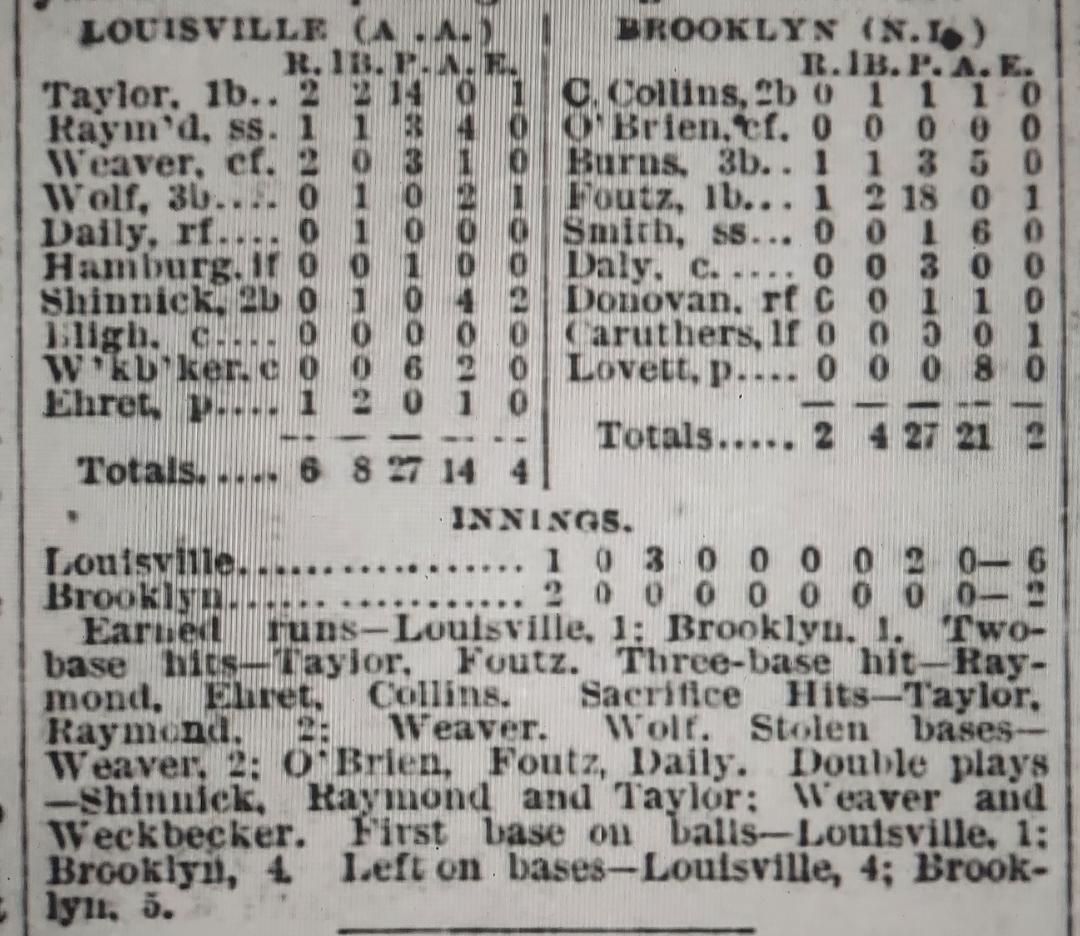
Louisville's young right-hander Red Ehret proved too savvy for the Bridegrooms, who were limited to four scattered hits.  Third baseman George Pinkney again did not play due to illness.  After taking an early 2-1 lead in the first, Brooklyn did not score again.  Facing 30-game winner Tom Lovett, the visiting Colonels scored three decisive runs in the third, then added a pair in the eighth for a 6-2 final margin of victory.  Seven games have been played, with each team winning three and one ending in a tie.  And that's the way it will stay.  Only a few hundred fans braved the frigid conditions at Washington Park.  Before the game, President Byrne and the Colonels' manager Jack Chapman agreed to postpone the rest of the series due to inclement weather and revisit it in the spring.  Thus, the 1890 World's Championship ended in a draw and brought the 1890 baseball season to a close.


Monday, October 24, 2022

BEFORE the BUMS 10/24/1890: Brooklyn Bridegrooms and Louisville Rained Out Second Consecutive Day at Washington Park

From the desk: FINGERPRINTS OF DEM BUMS

 
In baseball's sixth ever World Series clash of 1889, the National League New York Giants defeated the American Association champion Brooklyn Bridegrooms six games to three, and an inter-city rivalry was born.  While this marked the New York Giants second straight championship victory over the Association, it would be Brooklyn's last campaign as an AA member club.  The following season, the Bridegrooms would make their National League debut where they remain to this day.  Welcome to "BEFORE the BUMS" my game-by-game rewind of (the city) Brooklyn's historic 1890 season.

1890
WORLD'S CHAMPIONSHIP
GAME SEVEN
Friday, October 24, 1890
vs.
FROM
Washington Park

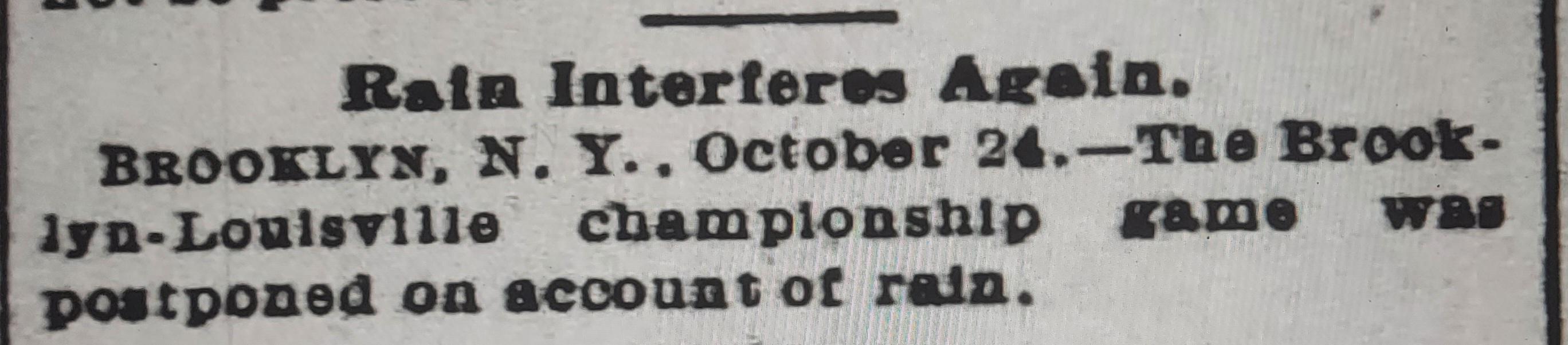
GAME CALLED: RAIN

Jupiter Pluvius continues wreaking havoc on the World's Championship series.  Friday marked the second consecutive postponement at wet and cold Washington Park while making this the third time rain has canceled play - including the first scheduled game at Louisville.  The Fates likewise continue to thwart any and all Bridegroom revelry.  After clinching the National League pennant on the road, they were due to arrive at the Fulton Street annex dock on October 1 at 10:00pm.  Team Secretary Charley Ebbets ordered barouches and a brass band to accompany the champions to Washington Park via Fulton Street, Flatbush Avenue, then Fifth Avenue to the grounds.  Fans and admirers were to illuminate the way with fireworks.  However, a railroad accident just outside Pittsburgh delayed their train back home.  The Bridegrooms did not arrive in Brooklyn until 1:30am with no welcoming soul in sight.  Charles Byrne's elaborate reception planned for Louisville's arrival in Brooklyn yesterday also went awry, compromised by this ongoing storm.  And for two days now, Byrne's sluggers have been denied the opportunity to hoist their championship banner up the flagstaff at Washington Park.  No celebration in the City of Churches for you!


Saturday, October 01, 2022

BEFORE the BUMS 10/1/1890: National League Champion Brooklyn Bridegrooms Welcome Home Derailed by Train Accident

From the desk: FINGERPRINTS OF DEM BUMS

 
In baseball's sixth ever World Series clash of 1889, the National League New York Giants defeated the American Association champion Brooklyn Bridegrooms six games to three, and an inter-city rivalry was born.  While this marked the New York Giants second straight championship victory over the Association, it would be Brooklyn's last campaign as an AA member club.  The following season, the Bridegrooms would make their National League debut where they remain to this day.  Welcome to "BEFORE the BUMS" my game-by-game rewind of (the city) Brooklyn's historic 1890 season.


Friday, September 30, 2022

BEFORE the BUMS 9/30/1890: Brooklyn Bridegrooms End Road Trip With Sweep of Cleveland Spiders

From the desk: FINGERPRINTS OF DEM BUMS

 
In baseball's sixth ever World Series clash of 1889, the National League New York Giants defeated the American Association champion Brooklyn Bridegrooms six games to three, and an inter-city rivalry was born.  While this marked the New York Giants second straight championship victory over the Association, it would be Brooklyn's last campaign as an AA member club.  The following season, the Bridegrooms would make their National League debut where they remain to this day.  Welcome to "BEFORE the BUMS" my game-by-game rewind of (the city) Brooklyn's historic 1890 season.


GAME #127
Tuesday, September 30, 1890
NATIONAL LEAGUE PARK

The National League Champions Are Coming Home

It took extra innings, but the Bridegrooms completed a sweep of the Cleveland Spiders and are now winners of four games consecutively.  Facing right-hander Bob Caruthers, Cleveland opened the scoring in the second.  Afterwhich, the teams traded runs in the fourth.  Brooklyn then seized a 3-2 lead in the fifth.  But it did not last.  After three scoreless frames, the Spiders tied the game in the home ninth, and into extra innings, they went at National League Park.  The Bridegrooms rallied for a run in the tenth, and Caruthers retired the Spiders in the bottom half of the frame for the win.  Second baseman Hub Collins and Oyster Burns led Brooklyn with two hits apiece.  The Grooms posted a 7-5 record during their final road trip and will arrive back in Brooklyn Wednesday evening, where a celebratory welcome home awaits the 1890 National League champions.
  • FINAL: BKN 4; CLE 3 10 innings
  • RECORD: 84-43 (.661); *FIRST PLACE, 6.5 GA of Chicago Colts


Sunday, May 02, 2021

On This Day at Washington Park 5/2/1908: Brooklyn Colored Giants Defeat Bronx F.C. in Battle of Boroughs

From the desk: KINGS COUNTY BASEBALL CHRONICLES
By 1906, Brooklyn Royal Giants' owner John W. Conner had struck up an acquaintance with one Charles Hercules Ebbets, president of the Brooklyn Superbas.  They agree that when the National League team is on the road, the still fledgling Brooklyn Royal Giants can play some of their home games at the refurbished Washington Park located along Fourth Avenue and Third Street in the Gowanus section of Brooklyn.  In 1908, this informal agreement is extended to Grant "Home Run" Johnson and his new aggregation, the Brooklyn Colored Giants who this season would play at Washington Park on the Saturdays that manager Pat Donavan's Superbas were away from home.

⚾

On Saturday, May 2, 1908, the Brooklyn Colored Giants featuring the great Grant "Home Run" Johnson host the Bronx Field Club at Washington Park.  Brooklyn scores early, often, and late in this latest battle of the boroughs en route to a commanding 12-1 victory over the visiting Bronx County nine.  

Grant Johnson this day plays behind the plate with Emery completing the battery.  Among Brooklyn batters, (SS) Paul, Grant Johnson, (CF) Murphy, and (2B) Gardner account for eleven of the Giants' hits.  Everyone in Brooklyn's lineup, except for (LF) Howell, scores at least once; Paul crosses the plate three times while third baseman Fuller and Johnson score two runs apiece, respectively.  


"The batting and fielding of the home team prevented the visitors offering the semblance of a close contest during the eight inning game, and when Brown went to third on Green's single and scored on Schaefer's hit to midfield the invaders saved themselves a shutout." - Brooklyn Daily Eagle


Bronx F.C. does themselves no favors in committing six fielding errors, including one by the catcher Schaffer and at least one each from all four members of the infield (two at shortstop).  Otherwise, the Giants amass fifteen hits against Bronx starter Riley, three going for extra bases, three walks; they swipe five bases and leave nine runners on base.  Emery earns the victory after yielding a lone run on six hits, two walks, ten strikeouts, and one hit-by-pitch for good measure. 


This second boxscore appearing in the Brooklyn Daily Eagle details the same game but with conflicting results.  The final score reads 11-1 in this account.  As opposed to Howell being the lone Giant to not score a run, he is herein listed with two runs scored and it is second baseman Gardner who fails to score from among the lineup.  Grant Johnson also goes from being credited with eleven putouts down to eight, and first baseman Smith increasees from five putouts to nine.  Brooklyn likewise goes from fifteen totals hits and none by starting pitcher Emery, to sixteen hits including two by Emery.  In turn, Bronx is charged with four errors, not six. 


UPCOMING GAMES AT WASHINGTON PARK:
  • Saturday, May 9, 1908: the Brooklyn Colored Giants host the Resolutes of Washington. 


Sunday, April 18, 2021

OTD 4/18/1925: Charles Hercules Ebbets Passes Away

From the desk: FINGERPRINTS OF DEM BUMS

GREENWOOD CEMETERY
BROOKLYN

Charles Hercules Ebbets, Sr. in 1882, began working as a vendor for the fledgling Brooklyn Baseball Club and soon thereafter assumed the responsibilities of Treasurer.  By 1890 he had elevated himself to the rank of shareholder and by 1898 owned upwards of 80% of the team.  To further facilitate constructing a new ballpark at 55 Sullivan Place, Charlie Ebbets needed to sell half his interest in the team to brothers Edward and Stephen McKeever.  Ebbets Field opened for business in 1913 and three years later raised its first National League pennant.  In 1920, the Superbas won another.  At the zenith of his life and career, the 65-year old Charles Ebbets stayed at New York City's Waldorf Hotel when he succumbed to heart failure during the afternoon hours of April 18, 1925. 


Sunday, October 18, 2020

Negro League Baseball, Ebbets Field and the Great Clash of 1920

From the desk of: FINGERPRINTS OF DEM BARNSTORMERS


During the forty-five years Ebbets Field stages major league baseball games, it hosts only brief interludes with African-American leagues and teams.

I've so far covered the last two instances:

What follows is the first and perhaps most famous episode involving Ebbets Field and Negro Leagues baseball.  When, why, and how, to borrow a Ken Burns phrase, is "something like a war" with Bedford Avenue and Sullivan Place serving as a transient battleground in a conflict pitting former partners, new alliances, power brokers, and regional titans.  The theaters of operation are Atlantic City, Harlem, and Brooklyn, where an inevitable showdown is gloriously waged at Ebbets Field.

PART ONE: John W. Connor vs. Nat Strong; Control of the Brooklyn Royal Giants

John W. Connor is an African-American born on Dec. 26, 1878, in Portsmouth, Virginia.  When he matures to the proper age, Connor enlists in the United States Navy and serves in the Spanish-American War.  Upon his honorable discharge, Connor heads north to New York City and becomes a highly reputable restauranteur and nightclub owner.  He owns and operates the Brooklyn Royal Cafe and Palm Garden on Myrtle Avenue in Brooklyn and Porter's Club in Harlem.

Mr. Connor is well known, is highly respected and has the confidence of the people in the community.  It can be said without braggadocio the Royal Cafe is the finest Afro-American cafe in Brooklyn.  Only a few white cafes can surpass it in beauty or in up-to-date service.  Mr. Connor's success is an inspiration to others. - The New York Age, Aug. 23 1906

Connor is also a baseball fan, and in 1904 he establishes the Brooklyn Royal Giants.  He invests in talent, and the team enjoys initial success.  For a brief time (1906-1907), the Brooklyn Trolley Dodgers share Washington Park with the Brooklyn Royal Giants.  

Sol White is a turn of the century player who both briefly plays for and manages John Connor's Royal Giants.  He is also considered the Negro League's first historian.  In 1907 he published The History of Colored Baseball.  In it, he writes glowingly of Mr. Connor:

"John Conner was the second race man to gain prominence as an owner of a professional baseball club.  Mr. Conner played a noble role in keeping the game before the public.  Like all true baseball men, he loved the game and went to the limit for the grand old sport." - Sol White, member of Baseball's Hall of Fame

During the seasons 1906-1909, the National Association of Colored Baseball Clubs of the United States and Cuba (NACBC) brings a small measure of order and organization to African-American teams in the East.  But it doesn't last.  By 1909, the association proves mostly ineffectual.  It is splintered into executive factions with Vice President John Connor on one side of the table, and on the other side, Secretary of the Board Nat Strong.  Connor resorts to booking his own games against outlaw teams not sanctioned by the NACBC and certainly not approved by Nat Strong, who effectively maintains a stranglehold on booking African-American and semi-pro teams throughout the East.  The NACBC is disbanded before the start of the 1910 season.  After this, Nat Strong is curiously brought into the Royal Giants fold as the team's official booking manager.  

Within three years, Strong wrestles control of the Brooklyn Royal Giants from John Connor.  As reported by the New York Age on July 13, 1913, John Connor "transferred" ownership of the Brooklyn Royal Giants to Nat Strong.  History never makes clear if money is exchanged or if John Connor ever receives compensation from Nat Strong for turning over the Royal Giants to him.

John Connor nonetheless gives his reasons for leaving the game:
  • He is tired of getting bad deals from white owners who did not want to give him a percentage of the gate.  Connor instead was being forced into accepting a guaranteed fee for his club's bookings rather than a split of gate receipts.
  • He is tired of having to continually deal with players threatening to jump their contracts.
  • His investment in the renovation of Harlem Oval had not paid off to his satisfaction.
  • After a highly successful run (1908-1910), the quality of play on the field had deteriorated over the last two and a half seasons.

Conner immerses himself back into business, while Nat Strong continues tightening his control as the East's preeminent booking agent.  Strong turns the Royal Giants into a traveling team with no home ground.  This affords Strong the luxury of scheduling games against the best white semi-pro teams, negro leagues teams, Major League squads, and all-star teams.  Strong, a white man, is a long-established baseball magnate having owned several of the metropolitan area's top white semi-pro teams dating back to 1903, the famous Brooklyn Bushwicks among them.  His partnership forged with Bushwicks' founder Max Rosner in 1916, and the accompanying access to Dexter Park further serves to fortify Strong's business enterprise.

Brothers Jeff and Ed McMahon arrive on the scene in 1911, when they found the New York Lincoln Giants and secure a lease at Olympic Field in upper Manhattan.  In direct opposition to Nat Strong, the McMahon's booking terms and promotional fees are more reasonable and more alluring to visiting clubs.  However, by 1914, the McMahon Brothers lose their lease on Olympic Field and are forced to sell the club.  Nat Strong promptly forms an alliance with new incoming owner James Keenan (and Charles Harvey).  Together, spanning the seasons 1914 through 1918, they collude to keep Negro League teams outside their sphere of influence, particularly from the Midwest, from playing within New York City limits.  However, in 1919, developers transformed Olympic Park into a parking garage forcing Keenan and Harvey to move their home games to the Bronx.

PART TWO: Rise of the Atlantic City Bacharach Giants

Meanwhile, one hundred thirty miles to the south, Atlantic City (New Jersey) is in the midst of a mayoral election.  To keep popular incumbent Harry Bacharach's name before the city's African-American population, Thomas Jackson, a political associate of Bacharach, suggests entering a team in the local African-American circuit with the name Bacharach across the uniform.  A second associate, Henry Tucker, is a native of Jacksonville, Florida, where he once managed several semi-pro African-American teams.  Tucker travels to Florida and recruits members of the Duval (County) Giants, Jacksonville's top independent semi-pro club.  The roster is further supplemented, and in May 1916, the Atlantic City Bacharach Giants take the field.  Harry Bacharach throws out the first ball and is shortly elected into office.  Local papers refer to them as the Mayors, although Harry Bacharach is never really involved with team operations.  That is left to Thomas Jackson and Henry Tucker.

By 1918, the team is in financial distress.  Thomas Jackson takes in two partners.  One is none other than John W. Connor, and the other is Barron D. Wilkins (restauranteur, Harlem nightclub operator, and former owner of the New York Colored Giants).  

To make real profits, Connor knows the team must venture north into Nat Strong territory - New York City.  Connor, in 1919, secures a lease for Dykman Oval in upper Manhattan and promptly begins booking out of town clubs.  He also begins raiding players from the Brooklyn Royal Giants and New York Lincoln Giants.  In turn, Strong and Keenan prevent teams under their control (such as the Brooklyn Royal Giants and New York Lincoln Giants) from playing in Atlantic City.  

PART THREE: The Baseball World Descends Upon Ebbets Field

If you recall, when Connor owned the Royal Giants the team took up residence for two seasons with the Brooklyn Dodgers at Washington Park.  He and Charlie Ebbets undoubtedly struck up an acquaintance because, with a phone call, John Connor can secure Ebbets Field, where Nat Strong holds no sway for the Bacharach Giants.

Having compiled a 75-29-1 record, by the end of the 1919 season, the Atlantic City Bacharach Giants are considered the best African-American team in the East after finishing in front of the local New York Lincoln Giants.  

From Oct. 19 through Nov. 2, they play a five-game exhibition at Ebbets Field against a major league/minor league all-star team billed as the International All-Stars.  After losing the first two games, the Bacharach Giants rebound to win the next three.

On Oct. 28, 1919, Congress passed the Volstead Act. 

On May 16, 1920, the Bacharach Giants became the first African-American baseball team to play a regular-season game at Ebbets Field, against the Treat 'Em Rough semi-pro baseball team from Manhattan.  

John Connor's team in 1920 would play six games against African-American teams at Ebbets Field.  The first three games take place in July, including a showdown against their instant arch-rival.
  
NEWSPAPER CLIPS 
JULY 9, 1920 - "Why not a game between the Lincoln Giants and Bacharachs?  This is the big question in Harlem baseball circles today.  It is a known fact that John Connor, owner of the Atlantic City aggregation, is willing to play and, so he says, has been negotiating for some time with the powers that be for this game that beyond a doubt the baseball public wants to see.  On with the game.  We all want to see it." - Chicago Defender
JULY 11, 1920 - "...negotiations were started a week ago to arrange a double header between the Bacharachs and Lincolns, and it took hours of persuasion to induce the managers to agree to play." - N.Y. Tribune
July 11, 1920 - "The one big game fans have looked forward to for the past two years will finally come to pass when the famous Lincoln Giants hook up with John Connor's Bacharach Giants at Ebbets Field, Brooklyn, this Sunday in a big double header.  It has been a long time since we saw this - Cannonball Dick Redding vs. Smokey Joe Williams.  According to a statement given out recently by Joe Williams, he intends that his team shall take both games, so there you are.  The games will really be for blood and the admission price alone to see Joe pitch against Dick Redding will be well worth while.  All rooters, get ready for the big noise this Sunday and let your throats be clear.  The first game will start at two o'clock sharp!" - Chicago Defender

JULY 11, 1920 - "Followers of semi-pro baseball will be treated to a fine attraction between independent teams when the Bacharach Giants of Atlantic City and the Lincoln Giants, colored champions, clash in a double header at Ebbets Field, Brooklyn, on Sunday.  The contests will bring together the greatest colored semi-pro pitchers of a decade in Cyclone Joe Williams and Cannonball Dick Redding." - The Evening World, N.Y.


On July 11, the rivalry between newly formed alliances pitting John Connor/Barron Wilkins against Nat Strong/James Keenan comes to a head.  The Bacharach Giants and New York Lincoln Giants for the first time face-off in a double-header before an estimated 16,000 fans at Ebbets Field.  This marks the first time two African-American teams play each other in a Major League stadium in the East.  

The anticipation of an epic clash is palpable.  But far more than just a game for posterity sake or an on-field confrontation between business rivals and teams, this game, like many others, are societal events of the highest order where and when the African-American community puts on full display their uncompromising passion for the game of baseball.

If watching baseball in the 1920's meant leaving black dominated Harlem, the journey of crowds of several thousands to these stadiums, and their occupation of places otherwise associated with whites, was a quite different experience than leaving Harlem in small groups to go to work.  Crowds of fans claimed, albeit temporarily, spaces within the city for blacks.  Reporting the beginning of the Bacharach Giants 1920 season, Ted Hooks, the sports editor of the New York Age, describes a parade of automobiles following the team bus from Harlem to Dykman Oval, with many returning for several loads, filling the streets around the stadium with vehicles driven by blacks.  Black crowds likewise took ownership of the space of the stadiums.  Reporting the first Lincoln Giants-Bacharach Giants game at Ebbets Field, Ted Hooks writes, "Colored autos, colored sight-seeing cars, colored players, colored band, and, above all, colored umpires.  All the forgoing proved that they know their business..."  Inside the stadium, the press treated the games as social events as much as sporting contests: the New York Age gave several columns of their coverage to descriptions on the field, the team uniforms, the jazz band, the spectators and the noise they made, concluding, "... the game proved the colored fans the equal in deportment of any race that has ever graced Ebbets Field. - extract from Harlem and Baseball in the 1920's by Stephen Robertson
 
Bacharach Giants starter Dick "Cannonball" Redding pitches a 5-0 shutout over Smokey Joe Williams, but the Lincoln Giants rebound for a 7-5 victory in game two.

JULY 11 - "It was Dick's day and he pitched airtight ball.  The sunset tilt went to the Harlem boys.  Archer for the Lincolns pitched splendid ball." - Chicago Defender

In late August, the Chicago Giants come East to take on the Bacharach Giants.  The first four games are played at Atlantic City's Inlet Park.  Then, on Sunday, Aug. 22, the Bacharach Giants host Chicago for a series concluding doubleheader at Ebbets Field.  Atlantic City wins three games, loses one, and one game ends in a tie.  

AUGUST 22 - "Bacharach Giants play in Flatbush today.  The Bacharachs and Chicago Giants will meet in a double header this afternoon at Ebbets Field.  "Cannonball" Dick Redding, "String Bean" Williams and "Red" Ryan will do the pitching for the brunette Bacharachs.  The Chicago Giants will have John Taylor and Luther Farrell on the mound.  This game marks the first invasion of the East by these Western nines." - N.Y. Tribune
AUGUST 22 - "Joe Green's Chicago Giants were defeated in both ends of a double header Sunday at Ebbets Field.  Dick Redding, who pitched the first game, was in splendid condition and had the Westerners biting at his offering all the way.  In the nightcap Walter Ball opposed Red Ryan and both pitched splendid ball.  Twenty thousand persons saw the games." - Chicago Defender

In fact, Cannonball Redding throws a no-hitter in a 4-0 game one whitewashing of the Chicago Giants.  Atlantic City takes the second game as well by a 4-1 final.  Note: these two sources conflict on game one score.

  • On Friday, Aug. 13, 1920, the Brooklyn Dodgers defeat the New York Giants at the Polo Grounds to reforge a first-place tie with the Cincinnati Reds.

The Israelite House of David baseball team makes its first-ever visit to Ebbets Field on Aug. 28, for one game against the Bacharachs, who defeat House of David by a 7-0 final.

Atlantic City and Lincoln Giants once again come together for a doubleheader on Aug. 29, again pitting Cannonball Redding and Smokey Joe.

AUGUST 29 - "Brooklyn fans will not have to worry this afternoon about not having any major league ball game across the bridge, as Charlie Ebbets, in the absence of the Dodgers, has arranged a game for Ebbets Field between two of the strongest semi-pro teams in the East, the Bacharach Giants of Atlantic City and the Lincoln Giants of this city." - N.Y. Tribune
AUGUST 29 - "The two best semi-pro teams in the East will help swell the coal fund for Brooklyn's poor when they clash in a double header at Ebbets Field...  In the last game Dick Redding will oppose Joe Williams, and a battle royale as usual when these men meet will be in order." - Evening Public Ledger, Philadelphia
AUGUST 29 - "A battle of Giants will take place at Ebbets Field Sunday afternoon when the Lincoln Giants of this city and the Bacharach Giants of Atlantic City clash in the second of their series of double headers for the colored championship of the East.  Cannonball Redding will again hook up with Joe Williams in the curtain raiser." - N.Y. Tribune

Dick Redding again tops Joe Williams, this time dealing the Lincoln Giants a 6-0 defeat.

In September, the Indianapolis ABC's make their way to Ebbets Field.

SEPTEMBER 5 - "Although tomorrow is an off-day at Ebbets Field, so far as major league baseball is concerned, Brooklyn fans will not have to go to the Polo Grounds to see a good ball game.  Instead, all they will have to do is to go to the home of the Brooklyn Dodgers and watch the Bacharach Giants of Atlantic City and the A.B.C. team of Indianapolis clash in a double header." - N.Y. Tribune
SEPTEMBER 6 - "Brooklyn baseball fans will not have an idle afternoon at Ebbets Field today because of the absence of the Dodgers.  Charley Ebbets, through J.W. Connor and Barron D. Wilkens (sic) has arranged to have the famous Bacharach Giants of Atlantic City and the A.B.C. team of Indianapolis play the eighth and ninth games of their series for the colored championship.  To date the Bacharach Giants have the edge.  The teams rank among the best in the country and two good games are assured." - N.Y. Tribune

  • On Monday, Sept. 27, 1920, the Brooklyn Dodgers clinched the National League pennant.  Then on Oct. 7, the Robins take a 2-1 World Series advantage against the Cleveland Indians at Ebbets Field.

Shortly after that, the famed Chicago American Giants come East to play the Bacharach Giants for the "Colored World's Championship."  Chicago wins two of three at Shibe Park.  The next four games are played at Ebbets Field, where the Bacharach Giants, on Oct. 17, win both games of a doubleheader.  However, the American Giants take games six and seven to clinch the title.

On Oct. 23, John Connor and Baron Wilkins announce they will host an end of season banquet and invite Charlie Ebbets of the Brooklyn Dodgers as their guest of honor.

On Oct. 24, the Bacharachs take both games of a doubleheader against [Wait] Hoyt's Stars at Ebbets Field.  Hoyt, born in Brooklyn, spends a fleeting moment with the Boston Red Sox, and as a teenager, pitches for Erasmus High School.

John Conner has one last trick up his sleeve.  In a deal struck with Rube Foster, the Atlantic City Bacharach Giants become associate members of his Negro National League.  They retain independence but have no championship rights.  However, the Bacharachs benefit from fixed scheduling and NNL roster protections from other league members.  This arrangement also gives Rube Foster a business foothold in the East.  

Partners John Conner (this time of his own volition) and Barron Wilkins step away from baseball after the 1922 season.  Sadly, within two years, Barron D. Wilkins meets a tragic end when he is murdered in front of his own nightclub in Harlem.  In 1926, a 48-year old John Connor suffered a stroke and also passes away.   

In their head to head confrontation, I would argue that John Connor enjoys the last laugh over Nat Strong.  However, Strong's stranglehold in the East is ongoing.  He mounts a response in 1923 by founding (with partners) the Eastern Colored League to rival the Negro National League.  The first-ever negro World Series between competing major leagues is played in 1924, pitting the Kansas City Monarchs versus Hilldale.   

It is also debated that were it not for Rube Foster, Nat Strong would have come to dominate the West and virtually all of Negro Leagues baseball.  In the same breath, were it not for Nat Strong, perhaps Rube Foster would have come to dominate the East and virtually all of Negro Leagues baseball. 

POSTSCRIPT

What a way to ring in Prohibition, the Harlem Renaissance, and Roaring Twenties ...  

Imagine what the summer of 1920 in and around Ebbets Field might have been like.  I can hear the uproarious revelry now.  The Atlantic City Bacharach Giants become the first Negro League team to play at Ebbets Field.  In 1920, they posted a remarkable 100-37-4 regular-season record and brought top tier Negro League championship baseball to Brooklyn.  

Meanwhile, the Brooklyn Robins are winning their second National League pennant in five seasons.  A great time to be had by everyone.  Well, mostly, everyone.  The Brooklyn Royal Giants season was also culminating in a "Colored World Championship."  However, Nat Strong per his usual books, the championship series against the Cuban Stars in Washington D.C. at Griffith Stadium.  In October, the Royal Giants and Hilldale Club face off to decide a "Colored Champion of the East."  Nat Strong likewise books the four-game series just outside Philadelphia.  So much for Brooklyn being home sweet home.


Sources:
James E. Overmyer: Black Ball and the Boardwalk: The Bacharach Giants of Atlantic City
Center for Negro League Baseball Research
NegroLeagues.Bravehurst/The DonaldsonNetwork

Saturday, October 10, 2020

100 Years Ago Today 10/10/1920: Brooklyn Robins Lose Troublesome Game Five; Trail Indians 3-2

From the desk of: FINGERPRINTS OF DEM BUMS

100th Anniversary
BROOKLYN ROBINS
1920 NATIONAL LEAGUE CHAMPIONS

Brooklyn Robins vs. Cleveland Indians
League Park
"I've been in baseball for 40 years and I never saw one like this." - Wilbert Robinson
Game Five at Cleveland features a historical if not ponderous series of events Brooklyn Robins fans for all the wrong reasons will not soon forget.

Although no longer the perennial 20-game winner while with the Giants, 33-year old Rube Marquard during the 1920 season is nothing short of clutch.  When Uncle Robbie needs him most his old friend repeatedly comes through with vintage performances.  Scheduled to pitch this day for the Robins, Rube Marquard prior to the game is arrested by Cleveland police outside League Park on charges of ticket scalping.  Marquard maintains his innocence claiming a misunderstanding.  But an incensed Charles Ebbets will hear non of it and releases Rube on the spot.  

Inside the park Burleigh Grimes hurriedly prepares for an unexpected start.  Looking on in attendance is former Cleveland Spider legend and baseball's all-time wins leader Cy Young.  Pitching on three days rest, Burleigh Grimes by game time is still noticeably unprepared.  In the first inning Cleveland leads off with consecutive singles and a successful bunt hit by Tris Speaker.  With no outs and the bases loaded, right fielder and clean-up hitter Elmer Smith crushes a Grimes offering to deep right for a grand slam home run, the first in World Series history.  With Burleigh Grimes still pitching in the fourth, Indians starter Jim Bagby aides his own cause by homering deep to center field with two runners on giving Cleveland a commanding 7-0 lead.  His home run is the first hit by a pitcher in World Series history.  The Indians score one last time in the fifth inning off reliever Clarence Mitchell.

Brooklyn is not without its chances.  They strand a runner on second in the first.  Ed Konetchy triples in the second but on a sac-fly attempt is thrown out at home by left fielder Charlie Jameison.  In the third Burleigh Grimes bounces into a double play and the Robins strand two runners.  Hi Myers in the fourth removes himself from the base paths by getting thrown out attempting to steal third.  The fifth inning really makes all Robins shake their heads in dismay.  With no outs and Pete Kilduff and Otto Miller on base, Clarence Mitchell lines out to second baseman Bill Wambsganss, who immediately steps on second to retire Kilduff then tags an approaching Otto Miller to complete an unassisted triple play, again the first in World Series history.  Otherwise, the Robins go quietly until the ninth when Ed Konetchy drives in his first run of the series.  Alas it is too little too late.

Cleveland's 31-game winner Jim Bagby avenges his Game Two loss against Grimes, allowing one run on 13 hits and no walks over nine innings complete.  Grimes in turn takes the loss after yielding seven runs on nine hits and a walk in just 3.1 innings pitched.

Monday, August 31, 2020

100 Years Ago Today 8/31/1920: Brooklyn Robins Take Back First Place As September Looms

From the desk of: FINGERPRINTS OF THE BUMS

100th Anniversary
BROOKLYN ROBINS
1920 National League Champions

Game #126: Tuesday, August 31, 1920 - BR
Brooklyn Robins vs. St. Louis Cardinals
Sportsman's Park

First Place Brooklyn Robins Achieve Victory Number Seventy with Twenty-Nine Games Left to Play 

Message to Uncle Robbie: Don't look back or you just might see who is behind you.

After all, New York City is still John McGraw's empire.  But it's also a not so subtle reminder that the National League pennant is up for grabs. 

If over these last five months you've remained a member of the staunch Brooklyn skeptics and Robins naysayers, then perhaps Tuesday's contest finally swayed you into believing this surprisingly irrepressible team - virtually unchanged from last season - genuinely stands poised to win another National League pennant.  From the lips of yours truly to the ears of Charlie Byrne!  But the McKeever Brothers and Charlie Ebbets himself believe this to be true.  Fans filing into 55 Sullivan Place in exponentially record numbers are all the proof they need.

With Tuesday's 5-2 victory at Sportsman's Park the Robins finish the month of August with a modest 14-13 record.  However, the true significance of Tuesday's game is that it marks Brooklyn's seventieth victory of the regular season.  It's one win above last season's total; thirteen more than achieved in 1918; and presently matches their 1917 output.  Only difference being this year's Robins still have twenty-nine games left to play.  Everything now points back to 1916 when the Robins win 94 games and capture the pennant by a 2.5 game margin over Philadelphia.  It may take that many wins if not more in order to keep at bay the defending champion Cincinnati Reds and surging New York Giants.  But make no mistake, the road to the pennant presently courses through Brooklyn, as both Cincinnati and the New York Giants visit Ebbets Field in late September.

Back on the field, the Robins lose their series against St. Louis but at least salvage a victory in their final visit this season to Sportsman's Park.  Unlike yesterday Brooklyn stays a step ahead of the Cardinals with a 2-1 lead after three, trading runs in the sixth, then closing with two more runs in the seventh en route to a 5-2 final.  Bernie Neis getting a start in center field goes 2 for 5 with two runs batted in.  Hi Myers, Ed Konetchy and Pete Kilduff also drive in a run apiece.  Starter Jeff Pfeffer improves to 12-8 with a 2.90 ERA, after yielding two runs on seven hits and no walks with four strikeouts through a full nine.  Boston's extra-inning triumph over Cincinnati coupled with Brooklyn's victory once again gives the Robins a half-game lead over the Reds. 

Meanwhile, the New York Giants lose yet again at Forbes Field placing them two games out of first.  We know Wilbert Robinson and John McGraw are no longer the close friends they once were.  It seems the only things they have in common theses days are their respective issues playing Pittsburgh.

  • RECORD: 70-55 (.560)
  • 1st Place; 0.5 GA

Tuesday, July 07, 2020

100 Years Ago Today 7/7/1920: Second Place Brooklyn Robins Seizing League Wide Attention

From the desk of: FINGERPRINTS OF THE BUMS

100th Anniversary
BROOKLYN ROBINS
1920 National League Champions


Uncle Robbie and Brooklyn Trolley Dodgers Proving Naysayers Wrong With Best Start Since 1916 Season; Forecast as Second Division Dwellers Back in Spring, Robins Just One-Half Game Out of First Place.

It was right around this time last season when the Brooklyn Robins were teetering just above .500 with a 34-32 record, and mired in fourth place although a still manageable 9.5 games out of first place.  Improved to a point but hardly viewed as a threat by first division rivals, lest we forget at this point the regular seasons of 1917 and 1918 were effectively lost.  Cruel and unusual ways to follow up a pennant, to be sure.  But any optimism harbored by Uncle Robbie and the 1919 Robins unbeknownst to them was officially laid to rest on July 9 when they fall ten games behind league leading Cincinnati and henceforth remained out of first by no less than double-digits through season's end.  And as if anyone needs reminding last year's Robins ultimately ended the season in fourth place with a 69-71 (.492) record, a distant 27-games out of first place.

If nothing else finishing the 1919 season out of the second division for the first time in three years was somewhat significant for Mr. Ebbets who's seats were being filled once again by America's returning war veterans.  Whether attendance this season reaches 1916 levels again remains to be seen, but last season's turnout was certainly encouraging.  But even more encouraging is what continues unfolding on the field this season.  Charlie Ebbets and the McKeever Brothers could not be happier as the 1920 Robins continue muting pundits and naysayers with a 40-31 record, placing them just one half-game behind the first place Reds.  In turn jubilant Brooklyn fans are flocking to the ballpark in record numbers.

This season's ever growing scandal involving last year's World's Series between the Reds and Chicago White Sox reported as being fixed is fast escalating from a mere brushfire into a blazing inferno.  However if in fact the White Sox indeed conspired to throw the series, that should in no way detract from Cincinnati's National League accomplishment.  Make no mistake, the Reds are the legitimate defending senior circuit champions, just as the Brooklyn Robins were four short years ago, and as they aspire to be again this season.  At this point in 1916 the Robins were 40-25, and four full games ahead of the second place Philadelphia Phillies.

They have their work cut out for them but good things are happening at Ebbets Field.  Uncle Robbie is being rewarded for handing second base to Pete Kilduff, and likewise the third base assignment over to Jimmy Johnston.  Mr. Robinson's latest decision gone right was to hand right field over to Tommy Griffith.  The aforementioned three are by no means a trio of stand out players, but a solid  group of players making positive contributions.  We'd be remiss if Otto Miller were not included among the quiet contributors.  His confident handling of pitchers is exactly what Uncle Robbie wants.

The veteran first baseman 34-year old Big Ed Konetchy is once again yielding a lethal bat.  Out of action from May 28 through June 10, he has since elevated his average by thirty-five points to a season high .333 mark.  Like Konetchy, Zack Wheat missed the first week of June due to injury.  He returned to action on June 9 but struggled.  His .303 average upon injury plummets to .271 by month's end.  However in truth the Robins demonstrate many offensive shortcomings, which play a huge roll in Brooklyn posting a 12-16 record in June - for instance, making the league's more pedestrian pitchers appear like Cy Young for a day.

Brooklyn is presently in the early stages of their longest road trip of the season.  Having swept the Braves at Boston, the Robins enter tomorrow's series opener against the St. Louis Cardinals at Sportsman's Park on a five game win streak, and winners of nine of their last ten games.  Stops at Chicago, Cincinnati, and Pittsburgh still loom ahead.


1920 Brooklyn Robins - Baseball Reference

  • Next up: a five game series versus the St. Louis Cardinals at Sportsman's Park; one game is a make-up from a May 16 rainout.


Monday, May 18, 2020

Commemorating the 1920 Brooklyn Robins: Championship or Bust for Wilbert Robinson?

From the desk of:  FINGERPRINTS OF THE BUMS

100th Anniversary
BROOKLYN ROBINS
1920 National League Champions

One Month Into Season Brooklyn Robins Still Enjoying Representative Start. But Is Wilbert Robinson On The Hot Seat?

Looking back Charles Ebbets decision after the 1913 season to fire his dear friend and field manager is clearly the correct one.  The Dodgers in each of their four seasons playing for Bill Dahlen fail to finish above par.  In his final if not his best season at the helm Brooklyn posts a 65-84 record, good enough for sixth place, but clearly no longer good enough for Charlie and his brand new ball park at Sullivan Place.  It also goes without saying the subsequent decision to hire Wilbert Robinson entering the 1914 season pays off both quickly and handsomely.  Backed by an infusion of capital via Charles Ebbets new partnership with the McKeever Brothers, Robinson within three seasons transforms Brooklyn into National League champions.  Himself a former catcher and someone who previously serves under John McGraw as pitcher's coach for the New York Giants, Wilbert Robinson immediately moves to improve his battery.  Brooklyn signs pitchers Jeff Pfeffer, Sherry Smith, and catcher Otto Miller.  In 1915 they bring into the fold veteran Rube Marquard who already enjoys a rapport with Robinson since their days together with the Giants.  With the National League's best team ERA in 1916, the Brooklyn Robins reset the club's all-time attendance record en route to winning their first and to date only pennant of the 20th century.

The very next season Brooklyn plunges headlong into seventh place, eleven games under .500 and a distant 26.5 games out of first.  Never before does the National League witness such a precipitous fall from the mountain's top.  Despite efforts in January of 1918 to further solidify their pitching by trading the unrepentant Casey Stengel to Pittsburgh in exchange for pitchers Burleigh Grimes, Al Mamaux, and infielder Chuck Ward, Wilbert Robinson's club continues toiling in the second division.  Last season's 69-71 record marks the second of back to back fifth place finishes, this one ending 27-games behind the eventual World Champion Cincinnati Reds.  One must now ask if after three disappointing seasons does a fourth consecutive losing campaign place Wilbert Robinson on the same footing whence Bill Dahlen once stood.  To that effect Brooklyn returns this season save for a few patchwork acquisitions with essentially the same team.  Naturally many pundits spend spring training anticipating more of the same out of Brooklyn while regarding their cross town rival Giants ahead of the Pirates and Cubs as top senior circuit contenders for Cincinnati's crown.

Seemingly undeterred the Robins so far are off to a fairly good start, sporting a 12-9-1 record.  They presently occupy third place behind the league leading Reds, and second place Pirates.  However they have become quite taxed of late as six of their last nine games in May extend into extra innings.  On the first day of the month they play a major league record 26-innings at Boston.  The very next day they play 13 innings against Philadelphia at Ebbets Field, and the day after that play another 19 innings back at Boston.  Most recently three of their last four games are decided in extra innings.

Otherwise to Wilbert's delight the Robins are stunting opposing batters with strong pitching.  Burleigh Grimes owns a 1.32 ERA through his first 74.2 innings pitched.  The now veteran Leon Cadore drafted by the Dodgers in 1914 presently owns a 1.28 ERA through 56.1 innings pitched.  And of course there is 32-year old Jeff Pfeffer who although struggling for decisions nonetheless owns a respectable 2.18 ERA through 33.0 innings pitched.  Al Mamaux, Sherry Smith, and Clarence Mitchell, when called upon are likewise performing well.

No longer a rookie still trying to win Wilbert's confidence back in 1914, the now 31-year old Hi Myers in 1919 leads the circuit with 14 triples, 73 runs batted in, and a .436 slugging average.  The Robins center fielder this season is hitting a nifty .345 through 22 games.  Meanwhile soon to be 32-year old Zack Wheat is batting .323, and has hit safely in all but three games to start the season.

This week rumbling skies over St. Louis continued storming down upon Brooklyn's scheduled four game series against the Cardinals at Robinson Field - something Uncle Robbie seems agreeable with.


EARLY SEASON HIGHLIGHTS:

* Join me this season as I commemorate the Brooklyn Robins 1920 National League championship.  I am recapping each regular season game in real time with a little touch of poetic license, of course.